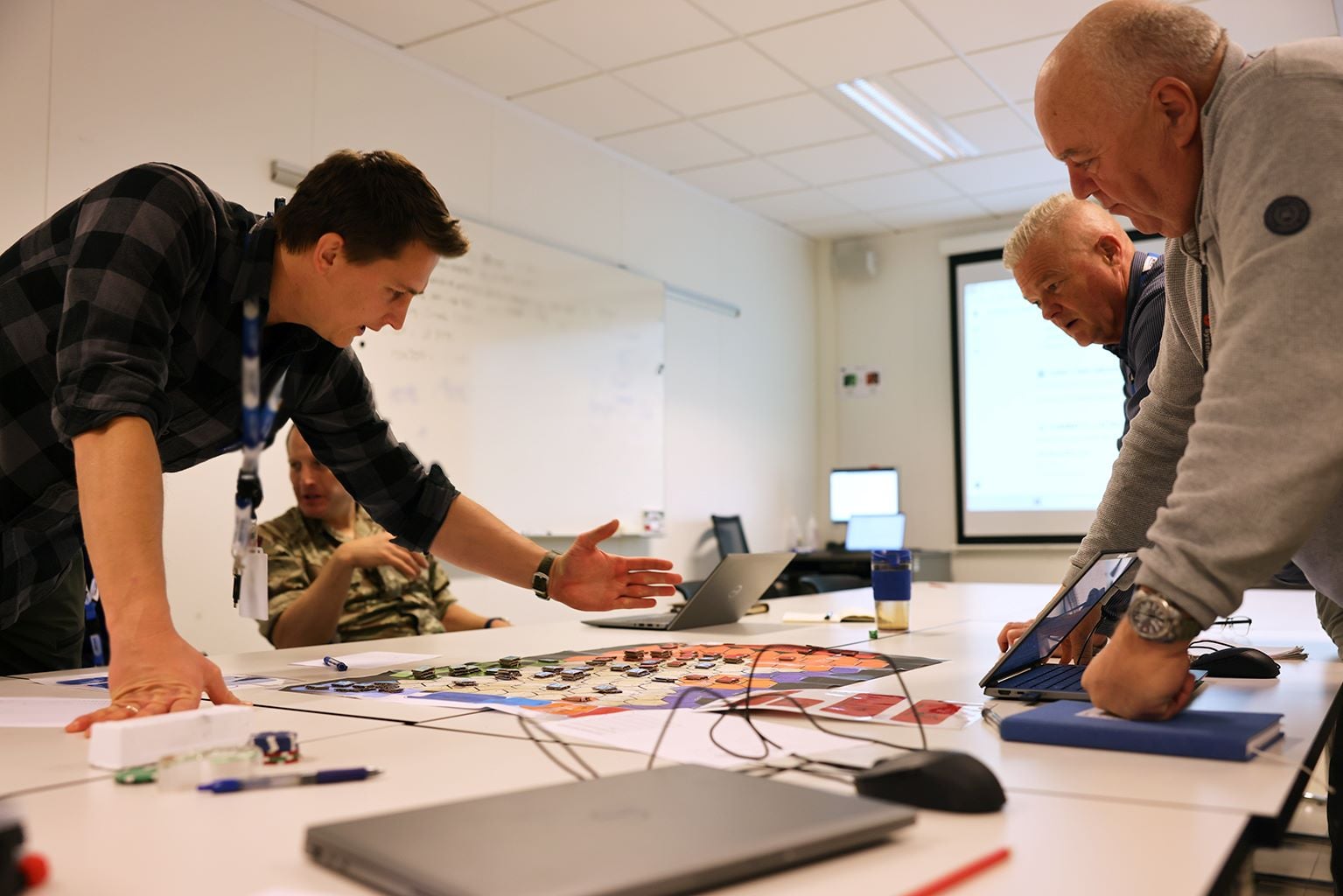
STAVANGER, Norway – The NATO Joint Warfare Centre (JWC) held its first artificial intelligence (AI)-enabled wargame experiment, Frontlines of Rasputitsa, on November 28.
The aim was to determine the viability of human–AI teaming in military wargaming, providing empirical evidence to guide AI integration strategies and establish operational prerequisites for its use in JWC-led training and planning environments.
“By integrating AI into all aspects of wargaming simultaneously, Rasputitsa provided a unique perspective on the challenges and opportunities of human-AI collaboration in military simulations,” said Major Wade, the JWC’s Wargame Director.
Major Wade explained that the Frontlines of Rasputitsa project is a NATO-aligned evaluation of large language model capabilities across the spectrum of professional wargaming functions, conducted by the JWC Wargaming Branch.
“It systematically assesses AI performance in rule adjudication, player assistance, autonomous faction management, and scenario generation within a structured military wargame environment,” he added.
The JWC’s pilot AI-enabled wargame had three phases:
AI-Only Automated Gameplay, which tested AI’s ability to autonomously execute a complete wargame. It revealed strong narrative coherence but critical procedural failures.
Human–AI Cooperative Playtest (Initial Run), which assessed AI’s support in adjudication, rule explanation, and interpreting human intent. It had strengths in teaching but weaknesses in execution accuracy.
Enhanced Cooperative Playtest, which re-tested AI performance using structured rule formats and schemas. It showed significant improvements in rule compliance and adjudication clarity.
Wargame designer Dr Andras, who contributed to the development of Frontlines of Rasputitsa, said: “The wargame demonstrates that AI can provide meaningful assistance to wargame designers and facilitators when properly structured. It also delivers several distinctly new insights to NATO’s AI research portfolio.”
The JWC’s wargame design capability reached full operational capability on May 18, 2022, following a two-year development phase.
With this capability, the JWC makes tangible contributions to Allied Command Transformation’s NATO Warfighting Capstone Concept (NWCC), particularly Cross-Domain Command, one of the five NWCC Warfare Development Imperatives.