
STAVANGER, Norway – The Joint Warfare Centre’s (JWC) wargaming experts recently deployed to Allied Joint Force Command Brunssum (JFCBS) to conduct two wargames in preparation for the upcoming NATO Exercise STEADFAST DUEL 2025.
STEADFAST DUEL 2025 is one of NATO’s largest exercises this year: It is the first NATO exercise to simultaneously train NATO’s three Joint Force Commands: Brunssum, Naples, and Norfolk; it will exercise elements of NATO’s defence plans under the framework of NATO’s Concept for Deterrence and Defence; and it will strengthen NATO’s adaptation to stronger and more orchestrated multi-domain warfare at operational and higher tactical levels.
The JWC Wargaming Branch has been working on the two wargames since January this year: one wargame focused on key leader training (KLT) based on the exercise scenario involving senior leadership from JFCBS and across the Alliance, and the other focused on the topic of resilience through civil preparedness (RtCP) with various staff level officers and civilians from the resilience community of interest.
The wargames were executed on September 15 (KLT Wargame) and September 30 to October 1 (RtCP Wargame), respectively.
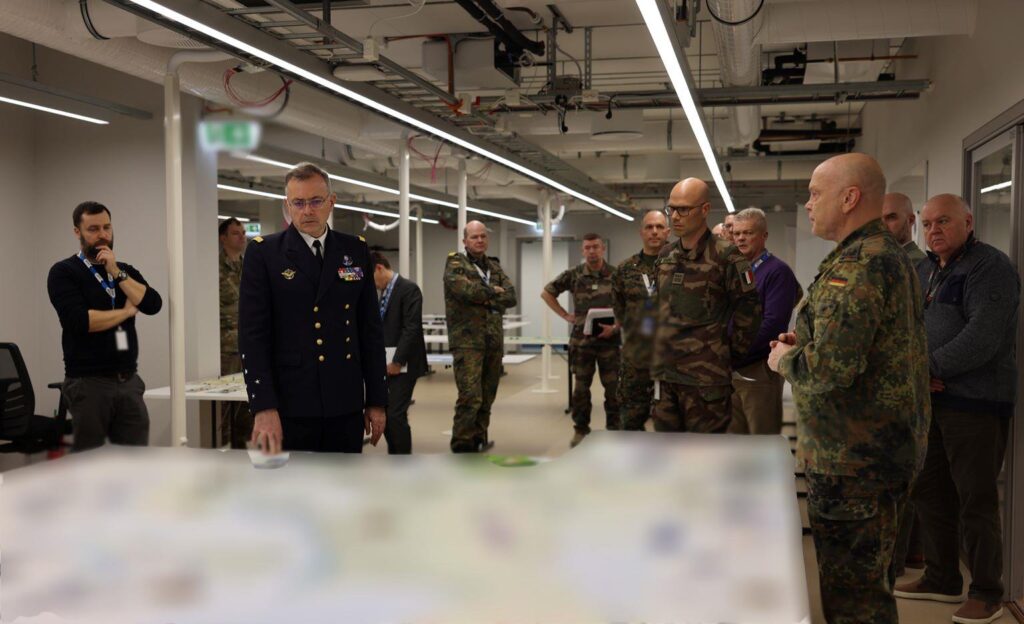
The Key Leader Training Wargame highlighted the importance of cross-functional collaboration and inter-command coordination, reinforcing JWC’s role as a trusted provider of wargames across NATO organizations.
Resilience through civil preparedness was a hybrid wargame which considered military and civilian linkages and ‘what ifs’ in a complex multi-domain scenario and has identified areas for further development.
Both wargames can be considered highly successful and will serve to validate JWC internal processes and our capability to provide wargames to NATO Command and Force Structure organizations.
Major Wade
JWC’s Wargaming Director of the KLT and RtCP Wargames
Wargame Objectives Met
Key Leader Training Wargame provided NATO’s senior leaders with an introduction to the STEADFAST DUEL 2025 exercise content, in addition to serving as a visualization tool to enable a common operational understanding of the exercise design.
For the resilience community of interest across NATO, the resilience through civil preparedness wargame helped enhance working relationships and common understanding of resilience related issues, while presenting the participants with a structured, problem-centred wargame.
“We presented the participants with scripted shock-effect injects driving analysis and discussion on national resilience risks and effects on NATO operational challenges. This will increase participants’ familiarization with the operationalization of the resilience through civil preparedness concept,” Major Wade explained.
“Simply put, we are providing NATO’s resilience community a structure for conceptualizing the process of Resilience Impact Coordination Meeting (RICM), updating of the Resilience Impact Dashboard (RID), and providing opportunities for further analysis.”
The JWC’s wargame design capability reached full operational capability on May 18, 2022, following a two-year development phase.
With this capability, the JWC makes tangible contributions to the NATO Warfighting Capstone Concept (NWCC), particularly the Cross-Domain Command, one of the five HQ SACT-led Warfare Development Imperatives (WDI) set out by the NWCC.