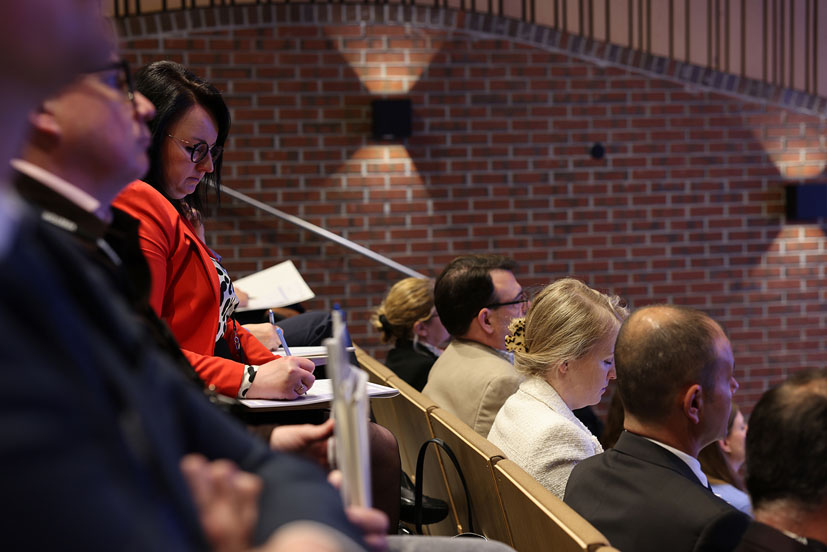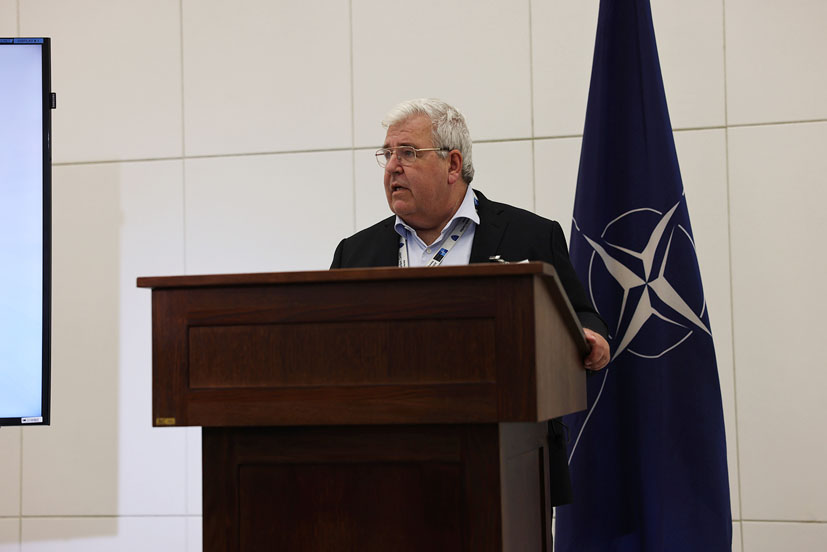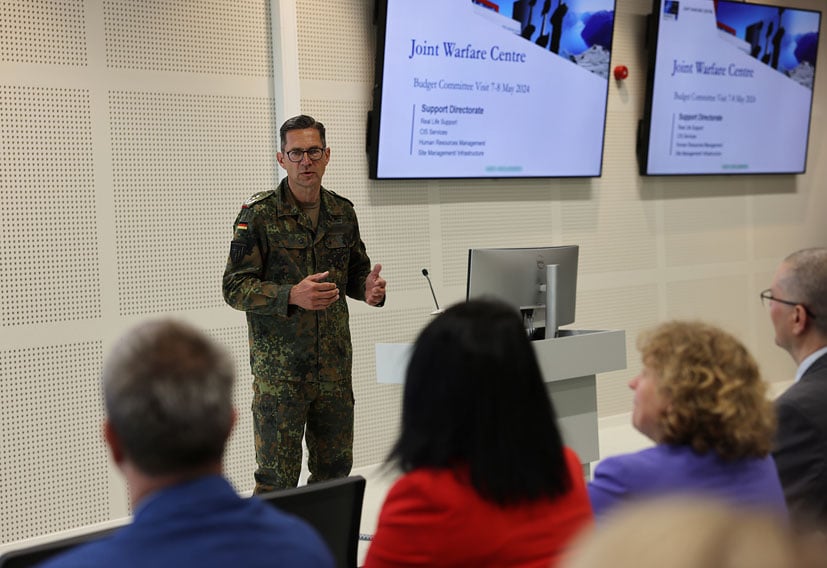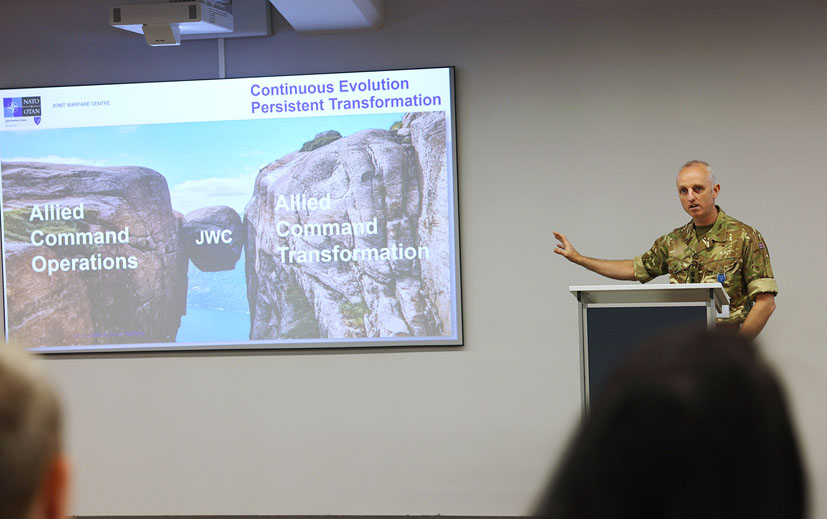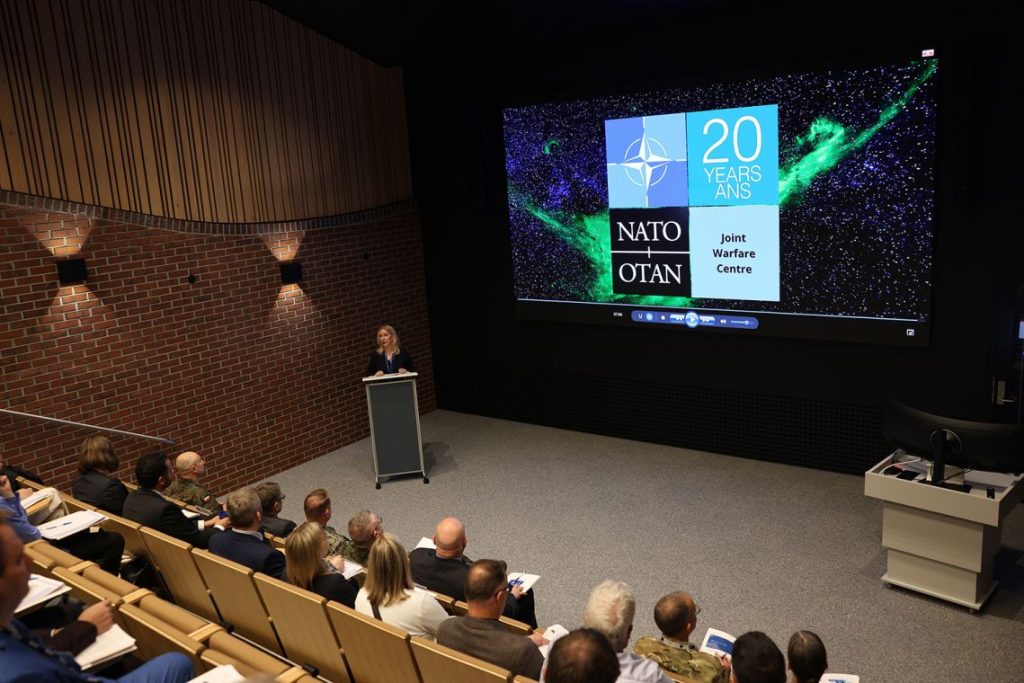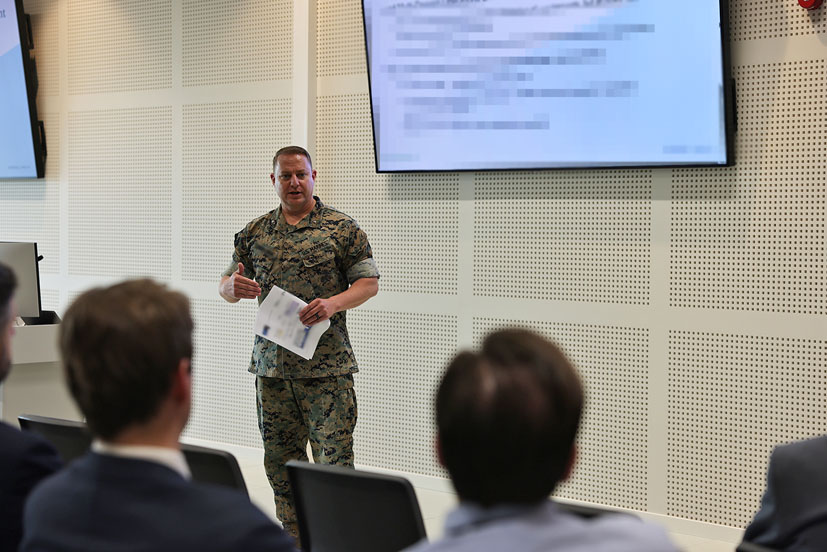

STAVANGER, Norway – The NATO Budget Committee visited the Joint Warfare Centre (JWC) on May 7 and 8, 2024, to learn more about the Centre’s pivotal role in ensuring NATO’s preparedness and evolution in an ever-changing global security landscape and discuss the Centre’s impact on NATO common funding and future capability development.
Presentations, videos, and demonstrations focused on the JWC’s dual role in collective training and warfare development, digital transformation and infrastructure updates, scenario generation and management, wargaming capability, and organizational change initiatives as reflected in NATO 2030, underpinned by sound budget and fiscal management.
On the first day of the visit, NATO’s top budget officials from 18 NATO member countries were welcomed to the JWC by Major General Piotr Malinowski, the Commander, who explained the significance of the JWC’s mission at the heart of NATO’s warfighting transformation, providing the bridge between NATO’s two strategic commands, Allied Command Operations (ACO) and Allied Command Transformation (ACT).
“I trust that today’s presentations will give you a better idea of the return on investment that the JWC offers to the Alliance and its 32 member states,” Major General Malinowski said.
Underscoring the increasing number, scope and scale of activities at the JWC, the Commander added: “In the past few years, we have doubled our exercise output. We have developed and implemented a new, highly realistic 360-degree setting. We have stood up a wargaming entity within the Joint Warfare Centre that is creating avenues for exercising aspects that other training activities don’t cover. Thousands of NATO warfighters and exercise control staff move through the JWC every year, even as we train many more at other locations.”
Major General Malinowski stressed that the JWC constantly aimed to “improve, expand and innovate” in order the make NATO better and stronger than ever.
Afterwards, Ms Helena Potter, JWC’s Financial Controller and Head of Budget and Finance Office, delivered remarks and expressed the Centre’s profound gratitude to the Budget Committee for their continuous support.
“Through innovative training methodologies and cutting-edge simulation technologies, we are dedicated to enhancing the readiness and interoperability of NATO forces, working hand in hand with ACO and ACT. We prepare the next generation of NATO forces through realistic and challenging exercises; we instill in them the mindset and skills necessary to respond swiftly and decisively to emerging threats and for the ‘fight tonight.’ Your support in approving our budgets enables us to conduct these exercises with the highest standards of excellence and effectiveness,” Ms Potter explained.
In the past few years, we have doubled our exercise output. We have developed and implemented a new, highly realistic 360-degree setting. We have stood up a wargaming entity within the Joint Warfare Centre that is creating avenues for exercising aspects that other training activities don’t cover. Thousands of NATO warfighters and exercise control staff move through the JWC every year, even as we train many more at other locations.
– Major General Piotr Malinowski, Commander JWC
Following the JWC mission brief and introduction to the Centre’s budget and contracting processes, the Budget Committee paid a visit to the JWC’s In-Rock Facility, which was re-opened in September 2022, following the completion of a two-year modernization project.
The briefing here was led by Colonel Fide Schönrade, the JWC’s Deputy Chief of Staff (DCOS) for Support Directorate.
The In-Rock Facility provides the JWC’s second combined joint operations centre and additional training space.
This includes multi-functional office spaces accommodating up to 600 people, meeting rooms, a real-life support office, and a CIS service desk to facilitate delivery of NATO’s most complex computer-assisted command post exercises (CAX/CPX) directed by the JWC.
Here, Colonel Kevin Rafferty, JWC’s Deputy Chief of Staff (DCOS) Exercises, Training and Innovation (ET&I) Directorate, together with his staff, provided the committee representatives updated information on a wide array of topics, including the new exercise process and the JWC’s new exercise series, STEADFAST DETERRENCE, STEADFAST DUEL and STEADFAST DAGGER; recent advances in modeling and simulation capabilities, NATO’s new force model, and the new organizational change programme.
Colonel Rafferty said: “There has been a paradigm shift to the new STEADFAST series of exercises. Over the previous 18 months, the exercises have been redesigned to meet the requirements of SACEUR for increased realism. They are larger in scale and are firmly nested between the operational and strategic levels; providing the opportunity to the NATO Command Structure and NATO Force Structure to refine their plans, directives and increase their readiness. The Joint Warfare Centre sits on the campaigning continuum and delivers deterrence for the Alliance.”
On the first day of the visit, the Budget Committee representatives were also updated on the real-life support to exercises, workforce, and ongoing and future infrastructure improvement projects at Camp Jatta by Colonel Schönrade and his staff.
One example is the opening of the G-Block in March 2024. Funded by NATO Security Investment Programme and carried out by the Norwegian Defence Estates Agency (NDEA), the construction of the new building is a 10 million Euro project. The G-Block provides new workspace for the JWC staff and plays an important role during exercises and training events.
The day concluded with a comprehensive presentation on media simulation, focusing on the media simulation capabilities JWC delivers in exercises, including television news, online news and social media simulation, which altogether enable the training audiences to deliver information effects in a highly complex simulation environment.
The Joint Warfare Centre sits on the campaigning continuum and delivers deterrence for the Alliance.
– Colonel Kevin Rafferty, JWC’s Deputy Chief of Staff, Exercises, Training and Innovation Directorate
The second and final day of the visit began with a presentation on warfare development given by Colonel Nicolas Tachon, JWC’s Head of Transformation Delivery Division, followed by a presentation on wargaming by the Wargaming Branch staff.
The JWC continues to broaden its range in wargaming products to provide a flexible and rapid training capability on demand. With its wargaming capability, the JWC makes tangible contributions to Supreme Allied Commander Transformation’s (SACT) Warfare Development Agenda and delivering deterrence and cognitive superiority.
Following a demonstration on wargaming attended by the Budget Committee representatives, Brigadier General Mark A. Cunningham, the JWC’s Deputy Commander and Chief of Staff, and Lieutenant Colonel Anthony Lancashire, spoke about the organizational change initiatives within the framework of the Fit for Future Programme, which defines the JWC’s roadmap in 2024 and beyond.
In this regard, the programme aims to build a common understanding of the scale and scope of the changes required to advance JWC’s capabilities through a coherent change delivery plan.
At the conclusion of the Budget Committee’s visit to the JWC, Mr Torgrim Alterskjær, Section Chief Budget and Disbursing, said: “This was a tremendous opportunity to meet and interact with the Budget Committee representatives. This visit could not have been accomplished without the joint efforts of the JWC staff.”
Alterskjær added: “We covered so many topics which are vital to the success of our mission and future capabilities. The visit also contributed to the Budget Committee’s understanding of the breadth of our mission and main activities. As I wrote back in 2014, some people may think of Stavanger as expensive, but the JWC is indeed the best training location from a cost perspective for operational-level command post exercises.”
The North Atlantic Council oversees the common funding processes, which are governed by the Resource Policy and Planning Board, the Budget Committee and the Investment Committee. (read more)
The JWC was established in Stavanger, Norway, on October 23, 2003. Its core mission involves enhancing collective training and warfare development across operational and strategic levels. By facilitating exercises and transformational activities, the Centre serves as NATO’s trusted advisor, seamlessly bridging operations and transformational initiatives.
You can connect with the Joint Warfare Centre on Facebook, X, YouTube, and LinkedIn.