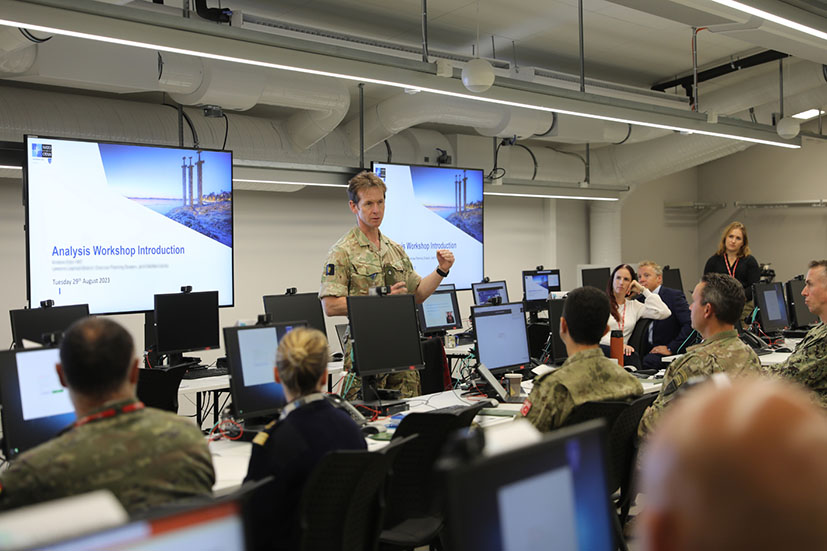

STAVANGER, Norway – From August 28 to 31, 2023, the Joint Warfare Centre (JWC) conducted its first Analysis Workshop in partnership with the Joint Analysis and Lessons Learned Centre (JALLC).
The aim of the workshop was threefold: firstly, to generate a NATO-wide analysis community of interest for meaningful exchange of ideas and best practices; second, to share existing and emerging analytical tools, techniques, and procedures in order to establish a more methodical approach to analysis, and finally, to provide a better insight into analysis provided by the JWC to assess exercise and training objectives’ achievement, and to support the lessons learned process.
Participants from across NATO, including analysts from Supreme Headquarters Allied Powers Europe (SHAPE), Centres of Excellence, subject matter experts from the JWC, Joint Support Enabling Command (JSEC) and the Joint Force Commands, along with two lecturers from the JALLC engaged in the workshop.
Welcoming the participants to the workshop, Colonel John Atkins, the JWC’s Deputy Chief of Staff (DCOS) Exercise, Training and Innovation Directorate, highlighted the dual aspect of the JWC’s important mission saying that “the JWC is not only a training centre, but also a warfare centre.” The JWC underpins its warfare development agenda, exercise and wargame planning and reporting, as well as the NATO lessons learned process with comprehensive analysis to prepare the Alliance for the future.
The increase in exercise ambition has driven closer coordination and cooperation between the analysis community which support our operations and exercises. As our experts are stretched to gain as much insight as we can out of our increasing exercise endeavours, we are lucky that we can reach out to our partners across the Alliance to work together with common tools and a common approach, to maximize our positive effect.
Led by the JWC’s Lessons Learned Analyst, Mr Andrew Eden, the workshop will also help optimize and expand the Centre’s capabilities as they relate to planning and delivery of exercises, and paves the way into the drafting of a JWC analysis guide.
Discussing the future of the NATO lessons learned capability and analysis, Mr Eden noted the importance of collaboration between analysts and exercise participants from different commands and missions throughout NATO.
He said: “The increase in exercise ambition has driven closer coordination and cooperation between the analysis community which support our operations and exercises. As our experts are stretched to gain as much insight as we can out of our increasing exercise endeavours, we are lucky that we can reach out to our partners across the Alliance to work together with common tools and a common approach, to maximize our positive effect.”
Eden also stressed the key role played by technology: “Artificial Intelligence presents an exciting opportunity for the Alliance to leverage the immense resource of exercise-derived data not just to increase our efficiency in conducting analysis but also to deepen our analytical capability.”
During the workshop, participants set out to explore analytic tools, techniques, and procedures through presentations, group discussions, and practical exercises under the guidance of two operational analysts from the JALLC, Jackie Eaton and Helena Worthington.
Information quality and cognitive bias were among the wide array of topics explored by the subject matter experts from the JWC and the JALLC.
Eaton observed: “I’m really encouraged by my first visit to JWC. Not only did the venue impress me as a fully-resourced centre for exercising excellence, but the workshop demonstrated the great potential for our cross-NATO collaboration. The melding of subject matter experts with analysis experts is a powerful alliance which will ensure that we achieve, and exceed, our warfare development ambitions.”
Eden added: “This has been a very positive initiative. The workshop has consolidated both the JWC team as creators and consumers of exercise insight, but also the wider analysis ecosystem within the Alliance. I’m looking forward to a very busy few years of exercise analysis ahead, working closely with our NATO partners and friends who contributed to this event.”